Social teams
Turn one campaign idea into a set of vertical hooks, cutdowns, and captioned variants for a busy feed.
The veed ai video generator helps turn a campaign brief into multiple starting cutsUse-case library
These Veed AI examples show how a single idea can become a social clip, product story, lesson, or faceless video without starting every edit from zero.
Turn an idea into a video| Deliverable | What appears in the video | Practical check |
|---|---|---|
| Clear opening | A hook, promise, or visual change in the first seconds. | The viewer knows the point before the second scene. |
| Useful middle | Proof, steps, features, or a short narrative arc. | Every shot earns its place and supports the brief. |
| Readable captions | Short lines timed to the spoken or on-screen message. | Captions remain legible on a small mobile screen. |
| Channel-ready finish | Correct framing, branding, sound, and final callout. | The export fits the destination without a second rebuild. |
Turn one campaign idea into a set of vertical hooks, cutdowns, and captioned variants for a busy feed.
The veed ai video generator helps turn a campaign brief into multiple starting cutsShow a feature through a short problem-and-solution story that gives prospects one memorable takeaway.
Veed AI for marketers keeps product examples aligned with a repeatable brand systemBreak a dense concept into a narrated sequence with visual prompts, chapter beats, and accessible text.
A veed ai caption generator makes lesson examples easier to follow and repurposeConvert a launch note or customer insight into a concise founder-led explanation for LinkedIn or email.
Veed AI text to video is a practical route from a rough script to a shareable storyBuild narration-led explainers, list videos, and story formats without needing to appear on screen.
Veed AI faceless videos pair narration, visuals, and captions for a consistent publishing rhythmA closer look at the output
The strongest Veed AI examples are specific about the job each asset must do. Start with the audience and channel, then choose the right input: a prompt for a fresh concept, a script for controlled narration, or source footage for a faster edit. Teams exploring a veed ai video editor workflow can keep the same structure while tightening pacing. For campaign work, image-to-video production adds movement to still product or editorial assets.
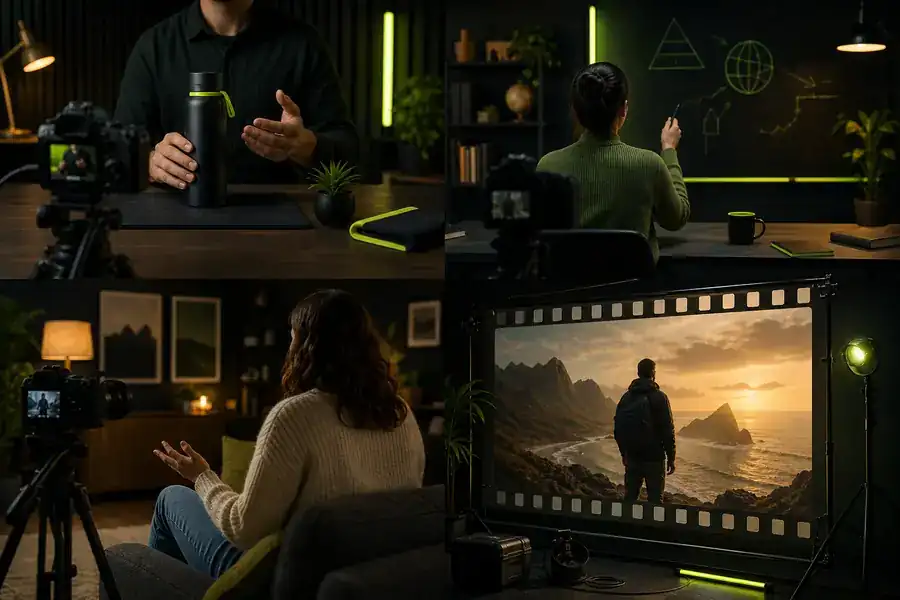

The transformation is not just visual polish: the finished cut makes the intended message easier to scan, hear, and act on.
A simple planning benchmark
Use this Veed AI planning calculator to set a realistic scope before you generate. It is an editorial estimate rather than a promise: more clips can create more options, but every option still needs a human check for accuracy, tone, and rhythm.
How video formats changed
Most rework happens when the format is chosen after the story is already assembled. A vertical social cut needs a different opening than a lesson, while a product demo needs proof earlier than a mood piece. These milestones explain why modern Veed AI examples begin with delivery constraints rather than decoration.
Creators started with fixed layouts and manually swapped media.
Short-form storytelling made hooks, captions, and pacing central.
AI began turning a plain-language brief into a first video structure.
Reviewers focused on factual accuracy, brand fit, and emotional timing.
The useful advantage is adapting a clear idea across channels.
Questions before you choose a format
A compact brief can go a long way
Use these planning targets to compare different Veed AI examples before committing to a full production pass.
Continue exploring
Choose the next page based on the asset you already have, the audience you need to reach, or the amount of editing control your example requires.